


 Back
Back Reasonable adjustments enable you to participate in the academic assessment process on a fair basis, and according to your preferences. Find out how to arrange reasonable adjustments that work for you.
Background
Reasonable adjustments allow you to fully participate in learning, assessment, university facilities and services. When it comes to assessments, for example, a reasonable adjustment could be making a video presentation instead of presenting in person, or having extra time in an exam, or showing your work to the tutor in private, rather than in front of a group. Under the UK Equality Act 2010, reasonable adjustments are required where disabled students experience substantial disadvantage in comparison with non-disabled people. Universities have an anticipatory duty to provide reasonable adjustments for students. This means your university needs to plan ahead and address any barriers that may potentially affect your studies and well-being. Some universities and some courses have risen to this challenge by putting in place systems that are on offer to all students, whether registered disabled or not. Examples are audio-recording every single lecture, or providing not just one route of assessment but several different ones for a particular assignment. However, currently this is the exception rather than the norm, and the more established route is to offer individual reasonable adjustments for specific requirements.
How does it work?
To be eligible for individual reasonable adjustments you need to have had an autism diagnosis and have told your university about your autism. The university’s ASC team then meets with you and discusses your needs. Ideally, this also involves an academic from the course you are studying. It is important that you are actively involved in this process, and also in making decisions regarding reasonable adjustments that work for you.
How could this affect me?
Accessing reasonable adjustments is about making your teaching, learning, and assessment fair for you.
Everyone learns differently at university. For some students, in order to succeed to the best of their ability, they may need more adjustments than others (say more time to complete an exam). But again, some students may need more time than others. It can be useful to think of the way we adjust assessment and teaching to this cartoon of children trying to look over a fence –
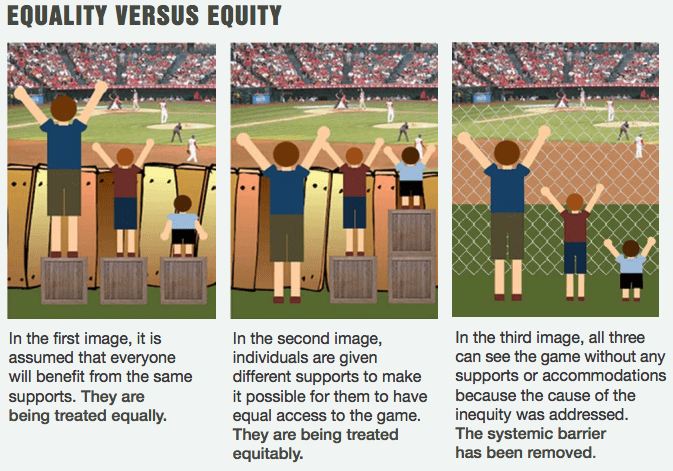
So if this example of the fence was a university exam – we could say that some students may need extra time to complete an exam (say 25%) while others may need more still (while some no extra time at all).
We recognise that all our students are unique have different ways of learning. We work with students to ensure their needs are met on an individual basis
What to do next?
Arrange a meeting with disability support AND your course leader
Practical tips
- If you can ASC team AND academics together
- Be open and honest about reasonable adjustments – what works for you individually? How do you learn best?
- Focus on learning outcomes rather than assessment procedures – what are alternative ways for you to evidence your knowledge and understanding?
- Ask academics to be creative, and potentially move away from tradition. Acknowledge that this can be uncomfortable for them.
- Remember that the ASC team is always there to support you, but they won’t necessarily know the academic requirements.
- Use the Autism&Uni Best Practice Guides as support
- Reply promptly to all communications regarding your support and reasonable adjustments, to ensure support is put in place when it’s needed.
Additional information
The Equality Challenge Unit has published guidance on reasonable adjustments to assist universities in planning and implementing them: http://www.ecu.ac.uk/publications/managing-reasonable-adjustments-in-higher-education/
About the author
ASC team & Autism @ Uni